Repeated exposure
The first response and day 14
The opening hormone rise was striking. Continuing the experiment changed the impression it left.
The reported LH increments
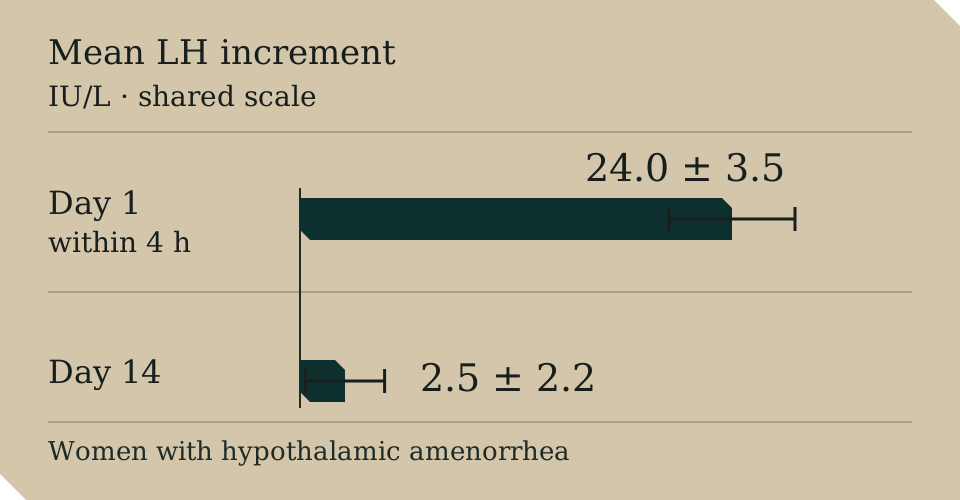
In a study of women with hypothalamic amenorrhea receiving kisspeptin-54, the mean LH increment within 4 h on day 1 was 24.0 +/- 3.5 IU/L. After repeated subcutaneous administration over 14 days, the day-14 response was 2.5 +/- 2.2 IU/L. These are the reported increments in LH, rather than measurements of the peptide itself.
An account ending at the opening rise leaves me thoroughly unconvinced. The later observation alters the practical question: can the system sustain a response while it continues to encounter the signal? In this experiment the initial effect weakened markedly. That finding deserves as much space as the first day's result.
Receptor desensitization
Tachyphylaxis names the rapid loss of response. A review of KISS1R pharmacology discusses receptor desensitization, internalization and the recycling of resensitized receptors as processes governing sustained and attenuated signaling. Internalization means receptors being drawn into the cell; recycling can return them to the surface.
I understand the fading response more readily once receptor behavior enters the picture. The receiving apparatus is active and changeable. An exposure can alter its future responsiveness. The review helps explain why a single administration and a continuous one can have very different effects on the reproductive hormone cascade; it does not establish a personal regimen.
During a continuous infusion
The infusion study in five women with hypothalamic amenorrhea makes the same difficulty visible on another timescale. Kisspeptin-54 restored pulsatile LH secretion, while the highest infusion dose produced tachyphylaxis during exposure. A stronger continuing input could therefore accompany a weakening response.
It would be too tidy to conclude that every continuing kisspeptin exposure must silence the system. The healthy-men infusion experiment reported increased LH pulse frequency. The populations, peptide forms and experimental exposures differ. I regard those differences as the substance of the problem.
The next experiment
The first peak has lost its monopoly on my curiosity. Persistence and recovery now seem at least as interesting. Repeated observations could establish when responsiveness returns, how reproducible that return is, and whether a meaningful reproductive outcome follows. Those are experimental questions. They provide no timetable for self-administration.
The pulse-reset experiment asks when a hormone pulse can be evoked. The fading-response experiment asks how that ability changes with continued exposure. Together, they make a peak-only account feel particularly incomplete.